
Built (#40/2025)
Short, interesting, engineering & infrastructure posts. One summary email every Sunday

Sydney Opera House Geometry
People often say the Sydney Opera House was inspired by an orange peel. That Jørn Utzon, the designer, conceived the idea while peeling an orange, and the building’s sails were shaped from those curved segments.
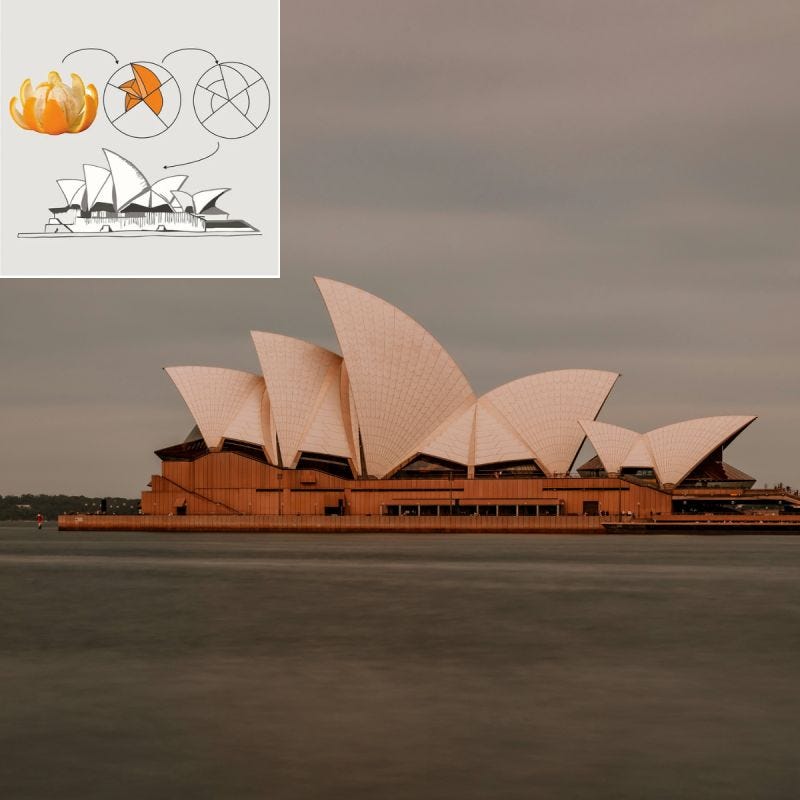
It’s a compelling story. But it’s a myth.
The truth behind the design is far more interesting from an engineering perspective.
When Utzon’s concept won the international competition in 1957, no one knew how to actually build it. The roof geometry was unsolved. The early designs employed parabolic and ellipsoidal curves, which proved impossible to construct accurately.
Years of modelling and testing followed. Nothing worked.
Then came the breakthrough.
Every shell was derived from the surface of a single sphere.
Each segment could be cut from that sphere with mathematical precision.
This breakthrough emerged from Utzon’s close collaboration with the engineering team at Ove Arup & Partners, particularly Peter Rice, whose structural ingenuity helped translate Utzon’s vision into a feasible form.
This simple geometric discovery made prefabrication possible. Every rib, tile and panel could now be built from standard moulds rather than one-off shapes. It was the difference between an impossible sculpture and a feasible structure.
That was the genius of Utzon’s engineering.
The orange peel story survived because it neatly describes the idea.
But the real insight was the spherical solution, which combined elegance, efficiency and practicality in one stroke.
The Sydney Opera House became one of the most recognisable buildings on Earth not through artistic chance, but through precise geometric engineering.
Xiaolangdi Dam Ski Jump
The awesome power of the ski jump spillway discharge from the massive Xiaolangdi Dam in China. The ski-jump spillway is an energy dissipation feature, chosen to protect the downstream channel from erosion when discharging very high-energy flows.
The ski jump design launches the water upward and outward in a controlled arc.
This dissipates much of the flow’s kinetic energy into the air before it lands, reducing its destructive impact on the riverbed.
The Yellow River, which Xiaolangdi controls, is infamous for carrying an extraordinarily high sediment load.
More than any other river worldwide. About 35 kg/m³ during peak flows, even up to 80 kg/m³ historically.
For comparison, the Mississippi River, another sediment heavyweight, averages closer to 1 kg/m³.
Xiaolangdi’s sediment issue is managed mainly through these low-level flushing and sluicing operations, not through the ski jump itself.
Check out the comment section for images of the other sediment removal operation. It’s as spectacular.
The ski jump, shown here, is used mainly during high-flow periods for flood discharge, when clearer surface water is released from higher levels.
This setup ties into the dam’s broader mission:
Built for flood control, sediment management, and hydropower, Xiaolangdi plays a starring role in taming the Yellow River, known for its devastating floods historically.
Not only does it look dramatic and super cool. It’s a critical mechanism in controlling flooding and sediment in the river.
Medieval Flying Buttresses
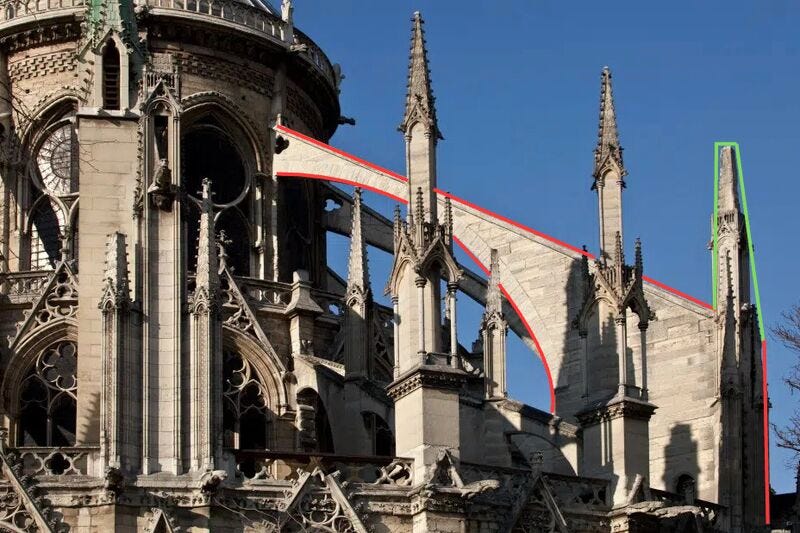
The ‘flying buttress’ system (in red and green) was one of the greatest structural innovations of the Gothic era. It enabled builders to construct soaring cathedrals with vast interior spaces, while walls could open up to feature expansive stained-glass windows.
Many marvellous cathedrals would not have been possible without them.
And if that happened, then you could not drag your spouse around on sidequests on a European trip and say “yes, but this one has cool flying buttresses...”
The most famous examples are those on Notre-Dame Cathedral in Paris, shown here.
When first introduced, the technology was groundbreaking.
A flying buttress is a specific form of buttress composed of a ramping arch that extends from the upper portion of a wall to a massive pier.
Its purpose is to convey to the ground the lateral forces that push a wall outward, forces that arise from vaulted stone ceilings and from wind loading on roofs.
What defines the flying buttress is that it is not in contact with the wall at ground level, unlike a traditional buttress.
Instead, it transmits lateral forces across the span between the wall and the pier.
A flying-buttress system has two main components:
(i) a massive pier, a vertical block of masonry set away from the wall, and
(ii) an arch that bridges the gap between pier and wall, the flyer of the flying buttress.
These supports counteracted the enormous forces of high ceilings and heavy stonework, making taller and lighter construction possible.
Elaborate pinnacles (marked by green) added even more weight, enabling the buttresses to resist greater thrust. Many assume they were decorative, but they were also structural (see the pinnacle images in the comments).
A Beer Pipeline in Brugge
Belgium has an operational 3.2km underground beer pipeline in Bruges. It connects Brouwerij De Halve Maan to its bottling plant. They required a method to transport 4,000 litres of beer per hour to their bottling facility located on the outskirts of the city.
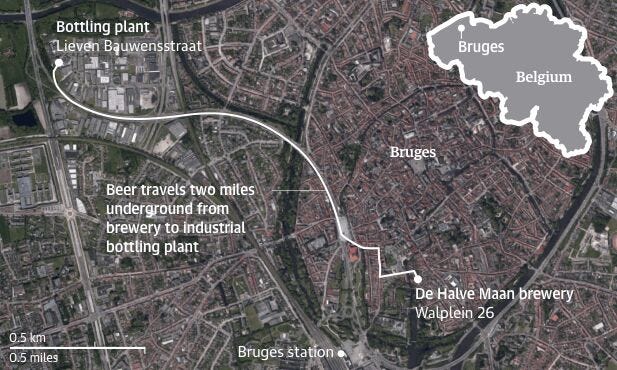
But the brewery is in the historic centre. Surrounded by centuries-old foundations, tightly packed buildings, and tourist-heavy pedestrian zones.
So they built the beer pipeline to solve the logistical challenge of moving beer across the UNESCO World Heritage city.
Excavation was out of the question.
So, engineers turned to horizontal directional drilling (HDD), a technique more commonly used for sub-river crossings and utility bores.
HDD is a method of installing underground pipes or cables by drilling a tunnel beneath obstacles, such as roads or rivers, without disturbing the ground surface.
The team used precision boring rigs to drill a series of guided arcs up to 34 m below ground.
This avoided the existing water, sewage, and telecom lines, and critically, it passed beneath Brugge’s fragile architecture without risk of settlement or vibration.
The pipeline itself is a multi-layered HDPE system, installed in three parallel lines: one for the unfiltered beer, one for cleaning fluids, and one for return flow.
Each line was pulled into place using a steel cable once the bore was completed and lined.
Flow is gravity-fed where possible, with pump-assisted sections managed by automated control valves.
Thermal insulation and pressure monitoring systems ensure the beer remains stable throughout transit.
It’s a fully engineered solution, designed to meet food-grade standards and urban constraints, while removing 500 tanker trips per year from the city centre.
Nice way to solve an infrastructure bottleneck (lol)
Dystopian Slope Protection
The strange, dystopian and brutalist beauty of these concrete cell anchor ties on Aogashima Island, Japan. These anchor ties protect the steeply sloped land against erosion.
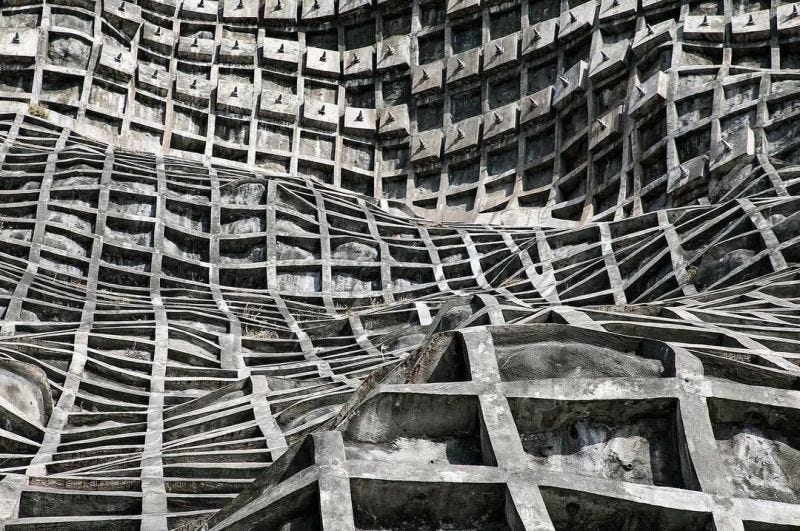
Infrastructure creates delight, if you care to look.
They are anchored with steel rods similar to rebar but stronger along their length to handle pulling tension deep into the bedrock.
Built into them are little drain ports with pipes. A type of filter/screen prevents soil and water from draining.
This drainage prevents water from building up and weakening the concrete, as well as preventing the land above from becoming so saturated that it causes other issues, such as sinkholes or other phenomena.
All the water that drains out goes into wide and deep trenches, also covered in concrete and embedded rocks poking out above the concrete floor to help slow down the flow of water, which all goes to the ocean or nearby bodies of water.
Just one of many ways to protect against slope erosion, and certainly one of the more visually interesting.
World’s Largest Airborne Wind Turbine
China has just flown the world’s largest airborne wind turbine. A 1.2MW system that floats like a Zeppelin and harvests energy from high altitude winds. By far the largest airborne wind-power generator ever built.
It’s called the S1500.
And no, it’s not fake.
Measuring 60m long, 40m wide and 40m tall. Inside its ducted wing sit twelve turbine-generators, each producing 100 kilowatts, for a total of 1.2 megawatts.
Unlike traditional turbines, the S1500 does not need a tower or deep foundation. This reduces material use by 40% and cuts electricity costs by 30%.
The entire unit can be moved within hours, making it suitable for deserts, islands, and mining sites.
Power is transmitted to the ground through a high-voltage tether cable hundreds of metres long
Earlier prototypes paved the way.
The helium-filled S500 reached 500 metres in 2024, generating 50 kilowatts. The S1000 later climbed to 1000 metres and doubled output to 100 kilowatts. These steps proved the concept before scaling to the S1500.
The attraction of airborne turbines lies in the physics.
High altitude winds are stronger and more consistent than surface winds. Doubling wind speed gives eight times the energy. Triple it, and the energy rises 27 times.
That exponential relationship makes high-altitude systems so powerful.
Such an airborne platform can be deployed quickly to remote sites, deserts or mining operations. It can even provide emergency electricity after floods or earthquakes, keeping radios and medical equipment running.