
Built (#25/2026)
Short, interesting, engineering & infrastructure posts. One email every Sunday

Fehmarnbelt Tunnel
The world's longest immersed tunnel is being built between Germany and Denmark.
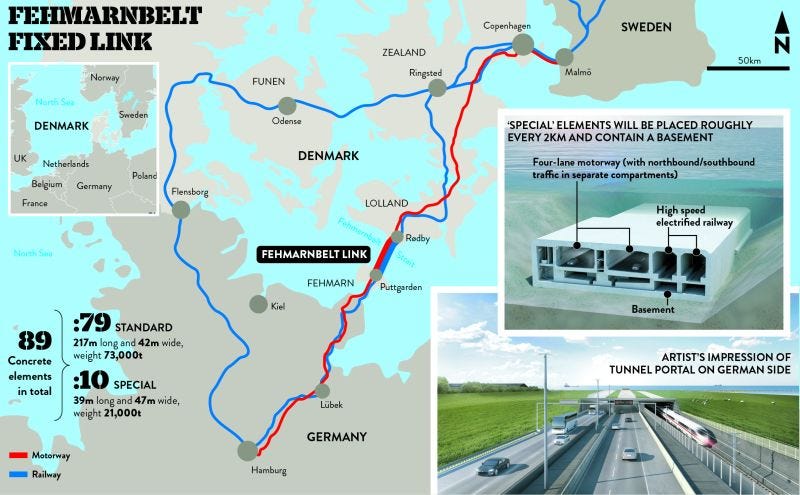
Once completed, the Fehmarnbelt Tunnel will stretch 18 kilometres up to 40 meters below the Baltic Sea.
After digging a trench in the seabed, workers will build 89 individual segments on land.
The tunnel elements use an enormous amount of concrete. Each standard element is 217 meters long, 42 meters wide, and 9 meters high and contains around 73,000 cubic meters of concrete.
In total, over 3.5 million m3 of concrete will be used for the tunnel.
Tugboats tow them out to sea, where they're partially filled with water and then lowered down to the seabed.
The tunnel elements must be placed with extreme precision. The tolerance for positioning each element is less than 30 mm horizontally and 50 mm vertically, showcasing the high engineering accuracy required.
These massive concrete structures are quite buoyant thanks to trapped air.
So, extra concrete is added to help them sink.
Operators connect the segments with hydraulic arms, pulling them together as water gets pumped out.
Pressure builds up, creating a vacuum and forming a watertight seal around rubber gaskets.
Workers can then enter from the previous segment and install a second watertight rubber seal and technical equipment.
Once completed, it'll take trains 7 minutes and cars 10 minutes to pass through.
The tunnel is scheduled to open in 2031 (delays have already been impacting the opening). It aims to significantly shorten the journey between Hamburg and Copenhagen for trains to about 2 hours and 30 minutes, reducing it from the current 4 hours and 40 minutes.
The tunnel is engineered to last at least 100 years with minimal maintenance.
Evergreen Burner
The Evergreen Burner™ is a device used in the oil and gas industry during well testing, built to burn off the liquid hydrocarbons that surge up from a well so cleanly that almost nothing falls back to earth.
Its job is disposal.
It safely gets rid of the excess oil that comes up while a well is being explored or developed, cutting fallout and smoke so the process stays cleaner and more efficient.
Think of it as a controlled way to burn off unwanted flammable liquid while keeping the surroundings less polluted.
During testing, a well has to flow real oil so its output can be measured.
That oil has to go somewhere.
Storing it offshore or in remote locations is expensive and often impractical, so the burner offers an efficient and cost effective alternative to oil storage for midsize flow rates and where there is a lack of existing infrastructure.
Burning crude badly is the problem.
It produces black smoke and a rain of unburned droplets called fallout, and the Evergreen burner exists to stop both.
It is a single head fitted with twelve nozzles that atomise the oil into a fine spray using compressed air rather than water injection.
Fine droplets and forced air give the flame enough oxygen to combust almost completely, which is what kills the smoke.
The numbers are interesting.
Independent certification body DNV measured its peak combustion efficiency at 99.84 percent and its peak fallout efficiency, over a one day cycle, at 99.999995 percent.
That second figure means only a few grams escape as liquid fallout for every tonne burned.
It handles heavy and waxy oils, copes with up to 25 percent water in the stream, and ignites reliably even into the wind.
Typical flow rates run up to 15,000 barrels per day, but cases have exceeded 17,000, reaching record surges of 20,000.
A water screen behind the head shields the rig from the radiated heat.
The whole assembly weighs just under a tonne and sits on a mount that swivels to follow the wind direction.
The point is not to burn oil faster.
It was to burn it so as to minimise the environmental cost of testing a well.
-
Evergreen Burner™ is a registered trademark of Schlumberger.
Dished End
Dished end manufacturing progress for one of our EPC projects in Africa. A tank dished end (also called a head) is the curved end cap that closes off a cylindrical tank or pressure vessel, rather than using a flat plate.
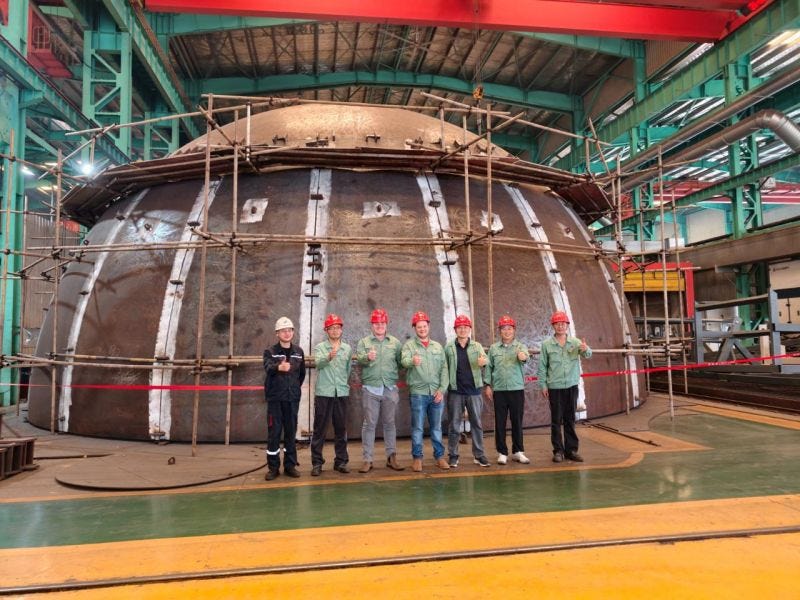
The curvature lets it handle internal pressure far more efficiently than a flat end—a flat plate would need to be very thick to resist bulging, while a dished shape carries the load largely through membrane stresses, allowing thinner, lighter, cheaper construction.
Despite our name, epcm predominantly executes EPC projects globally, with a strong home base in Africa.
Mostly in the hydrocarbon energy and space.
(...although sometimes we get involved with other things, like the malls we build and own in Southern Africa).
Fabrication takes place at our partner workshops around the world or at our own certified facilities just outside Johannesburg, South Africa.
And since we have an in-house engineering team based at our HQ in Pretoria, South Africa, we typically start these projects in the feasibility phase and take them through to supporting our own EPC projects and to commissioning.
If you think we can do something together, anywhere, give me a shout via DM, and we can get chatting.
Both as an individual and a company.
Who knows where a little chat can go?
Brunelleschi's Dome
The dome of Florence Cathedral is the largest masonry dome ever built—45.5 metres wide and rising over 90 metres above the ground. No one had built anything like it since the Pantheon, and no one knew how to build it in 1420 either.
There’s no rebar. No formwork. No modern analysis.
Just ingenious civil and structural engineering, executed brick by brick.
A 37,000-ton masonry dome without scaffolding, cranes, or concrete.
And they did it without knowing how it would hold together until it was finished.
Filippo Brunelleschi, a goldsmith with no formal architectural training, won the commission. And then redefined structural engineering.
The dome was constructed without an internal support structure.
Instead, Brunelleschi engineered a system of horizontal chains, herringbone brickwork, and self-supporting curvature so that each course of masonry locked itself into place as it rose.
Think of it like building an upside-down bowl out of bricks, one ring at a time, held in place by gravity and geometry.
To lift materials 90 metres up, he designed custom hoists powered by oxen, with reversible gears so they didn’t have to be turned around between lifts.
These machines were so advanced that Leonardo da Vinci sketched them decades later.
The dome is double-layered—an inner shell for structure, and an outer shell for weatherproofing and aesthetics. Together, they weigh more than 24 loaded Boeing 747s.
And 600 years later, it still holds.