
Built (#20/2026)
Short, interesting, engineering & infrastructure posts. One email every Sunday

Lego Tolerances
The insane engineering tolerances and quality production of LEGO.

A rectangular piece of plastic with eight studs on top and three tubes underneath, creating what LEGO calls clutch power, the satisfying snap that holds bricks together securely yet lets them be pulled apart with ease.
LEGO patented its brick design in 1958. To date, over 600 billion bricks have been produced, with roughly 36 billion added each year.
Every brick ever made fits because LEGO's manufacturing tolerance is around 10 micrometres, roughly a tenth the width of a human hair.
That is an almost unimaginable level of precision for mass-produced plastic components.
The process itself is unforgiving.
ABS granules are heated to 232 degrees Celsius until they reach a dough-like consistency, then injected into steel moulds under forces of up to 150 tonnes, with each brick cooling in roughly 15 seconds before ejection.
Out of every million bricks moulded, only about 18 fall outside tolerance.
18.
Out of a million...
This obsessive attention to detail, combined with advanced moulding techniques and rigorous quality control, has cemented LEGO's reputation as a pinnacle of manufacturing excellence.
ps: The name LEGO comes from the Danish phrase "leg godt," which means "play well."
Revolving Doors
Revolving doors exist because skyscrapers behave like giant chimneys. A swinging door at the base is essentially a hole in the side of that chimney. This is known as the stack effect.
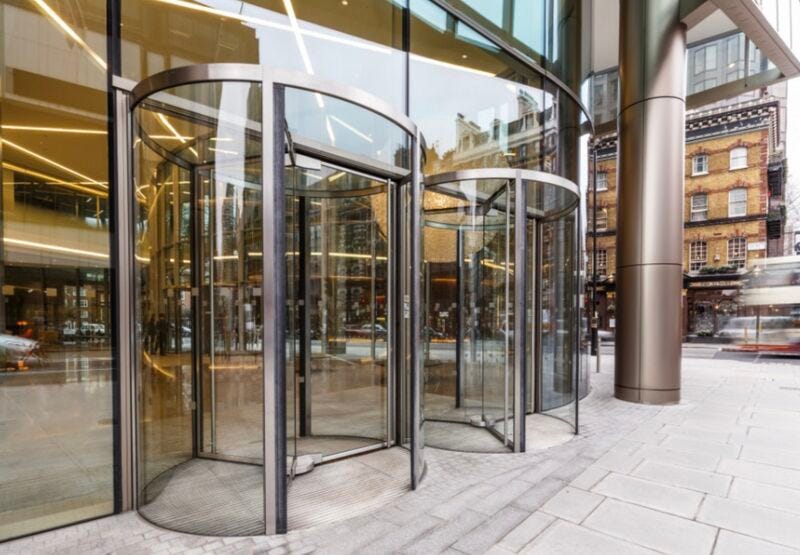
Civil, structural and mechanical engineers have to deal with this all the time.
Warm air inside a heated building is less dense than cold outside air, so it rises through elevator shafts, stairwells, and service risers, escaping at the top.
That upward flow creates negative pressure at the lobby level, actively sucking cold air in from the street.
The taller the building and the bigger the temperature difference, the stronger the pull.
In a 200-metre tower on a cold day, the pressure differential at ground level can exceed 50 pascals — enough to make a normal hinged door hard to open and, once opened, to blast a rush of cold air straight through the lobby.
The neutral pressure plane (where inside and outside pressures are equal) typically sits between 30–70% of the building’s height.
Below it, air is pulled in.
Above it, conditioned air is pushed out.
A revolving door solves this elegantly: it never creates a direct opening between inside and outside.
The rotating panels always maintain a seal, acting as a continuous airlock no matter how many people are passing through.
Theophilus Van Kannel patented his design in Philadelphia in 1888 (calling it a “storm door structure”), and within a decade, it became standard in tall North American buildings.
The engineering logic remains unchanged today.
But, beyond solving the stack effect, revolving doors deliver multiple other advantages:
- Energy efficiency: They reduce heating and cooling loss by up to 90% compared to swinging doors by minimising uncontrolled air exchange.
- High-volume traffic flow: They handle continuous pedestrian movement efficiently without ever fully “opening” the building to the elements.
- Weather protection: They block wind, rain, snow, and drafts far better than any vestibule with swinging doors.
- Noise and pollution reduction: They keep street noise, dust, vehicle fumes, and odours out of the lobby.
- Security: They create a controlled entry point, making unauthorised tailgating more difficult.
- Aesthetic impact: They provide a grand, stylish, and functional entrance that signals quality the moment someone approaches the building.
Modern high-rises still rely on revolving doors at street level, usually combined with mechanical lobby pressurisation, compartmentalised shafts, and airtight vestibules to further tame the chimney effect.
A hinged door at the base of a skyscraper is a point of failure in a structure that, from the perspective of fluid dynamics, is always trying to breathe.
Goat Canyon Trestle
This is the world's largest all-wood trestle, Goat Canyon Trestle, deep in the Carrizo Gorge of San Diego County
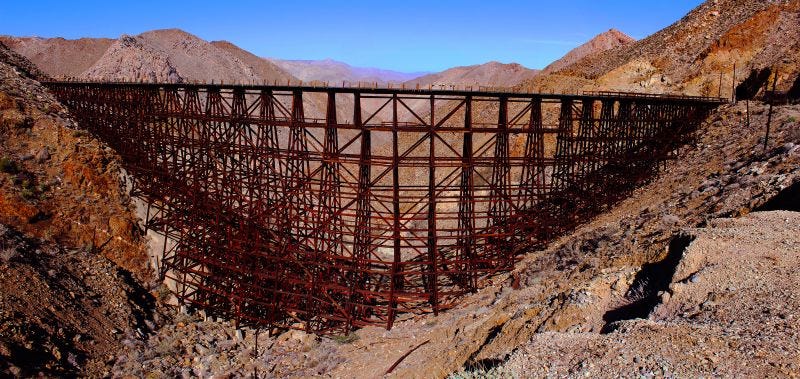
It operated between 1933 and 2008.
But now sits silent and unused. The fully intact trestle, visible only to hikers prepared for a long walk through the desert.
The redwood has outlasted every train that crossed it.
The structure is 229 metres long and rises 61 metres above the canyon floor.
It was built to solve a specific problem.
The San Diego and Arizona Eastern Railway, completed in 1919 after a decade of brutal construction through the Jacumba Mountains, relied on a series of 17 tunnels along its most rugged stretch.
When Tunnel 15 collapsed in 1932, engineers had two options: rebuild through unstable rock or bridge the canyon entirely.
They bridged it.
The choice of material was not sentimental (although I do find it very much so!)
Steel expands and contracts with temperature, and the Carrizo Gorge sees extreme swings between blistering summer heat and cold desert nights.
A common problem for any structural engineer.
Over time, that thermal cycling causes metal fatigue.
Redwood timber handles the fluctuation far better, so that is what the engineers used, from the deck to the deepest supporting bents.
The structure was assembled in sections at the bottom of the canyon and then lifted into position without nails.
To resist the gorge's high winds, the bridge was built on a 14-degree curve rather than straight, using the geometry of the structure itself to brace against lateral loads.
A tank car filled with water was stationed nearby throughout its working life, ready to fight any fire started by an ember from a passing locomotive.
The railway was called the impossible railroad from the moment it was completed, and the name kept earning itself.
Tunnels collapsed.
Hurricanes damaged the line.
Passenger service ended in 1951.
Freight traffic limped on, then stopped.
A 2004 attempt to run tourist trains ended when another tunnel failed.
And now, you can only visit this gorgeous engineering marvel on foot.
I love the article on revolving doors. Stack effects are a major design consideration in mining and particularly deeper mines in cold climates. Here in Saskatchewan we see -40C degree temperatures and +28C degree (year round) mine temperatures. A typical potash mine has two vertical access shafts, with shaft bottoms at -960 to -1100 metres below collar. Surface headframes to accommodate hoisting gear add another +/-40 to 100 meters. Typically we use either revolving, clamshell or airlock doors on surface and underground for personnel. They are separated by 200-400 meters.
Intake air is fed down one shaft and return air is exhausted up the 2nd shaft with volumes up to 500cms. Heating the air in winter, managing shaft and headframe temperatures and controlling airflows are challenging. Intake air is generally heated to +4C or in cases with shafts with tubbing to +20C and return air averages +28C at potash level and +19C at surface due to adiabatic expansion.
Impacts of stack effects are even more pronounced when one headframe is taller, especially if we loose power to the main intake/return air fans. This can result in complete reversal of the airflow. Other issues include -40C air leakage into the intake air headframe at the collar and impacts on mine water piping/personnel and saturated return air freezing on exit of the headframe and creating falling ice hazards.