
Built (#19/2026)
Short, interesting, engineering & infrastructure posts. One email every Sunday

Silver Bridge Failure
A 2.5mm crack. That was all it took to bring down the Silver Bridge over the Ohio River, USA, in December 1967, killing 46 people.
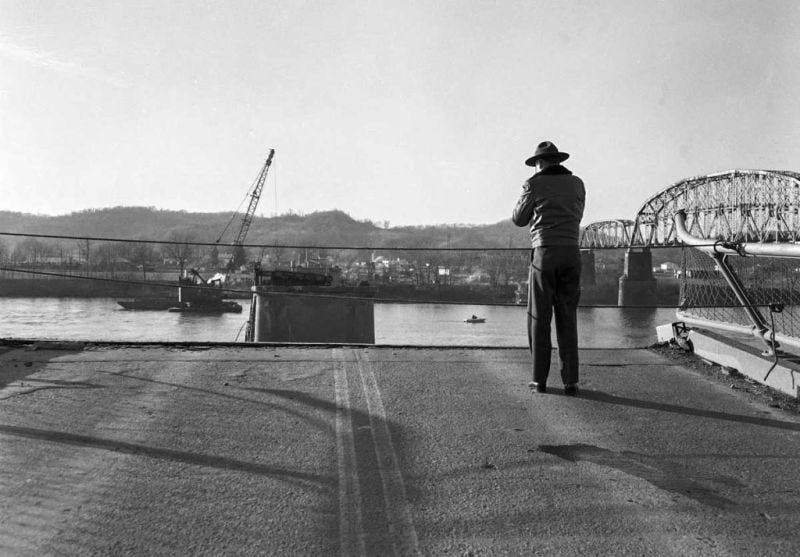
The bridge had stood for 39 years.
It collapsed in under 60 seconds.
Investigators spent three years trying to understand why.
They found plenty of rust across the wreckage, but eventually focused on a single eyebar, number 330, on the northern suspension chain on the Ohio side.
It had fractured.
The crack had not grown from impact or overload, but from stress corrosion and corrosion fatigue: water pooling at the base of the eyebar's pinhole had combined with tensile residual stress from manufacture to slowly grow a fissure over nearly four decades until it reached a critical size.
(see the additional images in the commentary)
At near-freezing temperatures on the evening of the collapse, the steel's fracture toughness dropped, and the crack propagated almost instantaneously.
The design gave the structure no way to survive it.
Where most suspension bridges of the era used woven wire cables, or eyebar chains built from four to six bars per link for redundancy, the Silver Bridge used chains of just two eyebars per link, each bar roughly 50mm thick and up to 17m long, connected by large steel pins.
When eyebar 330 fractured, the entire load transferred to its partner bar, causing it to slide off the pin.
The chain was severed.
Because every element of a suspension bridge is in equilibrium with every other, total collapse follows within seconds.
The eyebar chain design had been selected over conventional wire cables because it was the lower-cost alternative bid, and the unique joint geometry meant the critical location was inaccessible for visual inspection without disassembling the bridge.
The final accident report, released in April 1971, concluded that the design had made inspection all but impossible and failure all but inevitable.
The disaster directly led to the Federal Aid Highway Act of 1968, which established the National Bridge Inspection Standards, requiring all public bridges with spans over 6 metres to be inspected at least every two years.
So this disaster has really impacted every structural engineer since.
It is a clear example in structural engineering of how design decisions made to reduce cost and simplify construction can remove the redundancy that makes a structure survivable.
Erasmusbrug
I will take a stroll over this bridge in Rotterdam next week. Afterwards, I will visit Brussels and Düsseldorf. Accompanied by my colleagues Konrad Nieuwenhuizen and Alexandra Gazendam
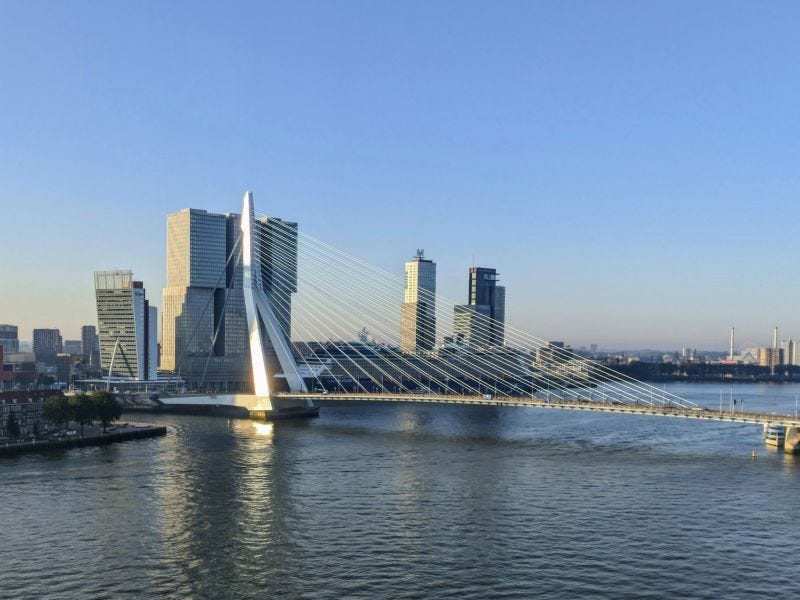
Partly to see clients and partners, and partly to eat stroopwafels, Belgian waffles, and drink alt beer.
Should be fun.
Get in touch with me if you would like to meet us.
We can discuss business (but I'm quite ok talking about infrastructure or food as well)
The bridge?
The Erasmus Bridge, nicknamed "The Swan," is an iconic 802-meter-long cable-stayed and bascule bridge in Rotterdam designed by Ben van Berkel and completed in 1996.
Known for its asymmetrical design, it is a key landmark over there. It includes Europe's largest and heaviest bascule bridge, allowing ships to pass.
The pylon leans backwards at 85°, originally conceived without backstays (a counterweight concept), but live-load analysis necessitated the addition of backstays.
About 140,000 ships pass annually; only ~500 require the bascule to open
Monadnock Building
This is the tallest load-bearing brick structure ever built, a record it still holds. The Monadnock Building in Chicago is 66 metres tall, has no structural steel frame, and has been standing since 1891.
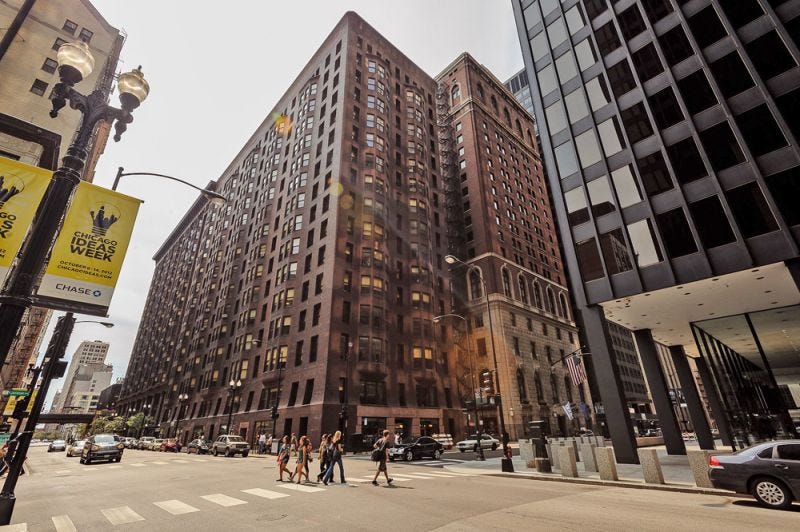
It's pretty as well.
The walls at ground level are 1.8 metres thick, tapering to 46 centimetres at the top.
Look closely at the image; you will see the wall thickening at street level.
That variation is not decorative; it reflects the precise reduction in compressive load at each storey, with each course of brick carrying only what the floors above demand of it.
All in compression.
To resist wind, iron struts were built into the masonry between the openings, the first use of portal wind bracing in the United States.
Chicago's soil complicated the problem.
The ground beneath is soft glacial clay, and a structure this heavy wants to sink into it.
Like, literally sink.
Engineers placed the building on a concrete raft reinforced with railroad rails, distributing the load over a broader footprint.
The building still settled roughly 0.6 metres, and the ground floor today sits one step below street level.
That settlement was anticipated and accommodated in the design.
Greater height was structurally feasible but commercially pointless; walls thick enough to carry additional storeys would have consumed the rentable floor area faster than the extra floors could recover it.
The south half, completed two years later by a different firm, used a steel skeleton with a brick curtain wall instead.
The Monadnock was the first building in Chicago wired for electricity, and one of the first to use fire-resistant hollow clay tile to protect its internal ironwork.
Its staircases were among the first structures anywhere to use aluminium structurally, at a time when the metal cost more per kilogram than silver.
The structural engineering argument for load-bearing masonry at this scale effectively ended with this building; steel framing rendered it obsolete within a decade.
What a pity, as I buildings in compression will last forever (no reinforcement that rusts)
Engineering is magic
There is no limit to what humans can accomplish. Let that fill you with optimism and a sense of adventure.
Human beings were hardwired for adventure.
To hunt and hoard. To fight and conquer. To rise against challenges and adversaries and emerge victorious.
Failure was never an option.
Victory or death.
That's why we use sport as a proxy for conflict. We crave the conquest. That's why our natural state is to build things.
We were not wired for a placid life on a hamster wheel of 9-5s, endless streaming services, processed foods and social media scrolls.
Get involved in something where you feel you are part of an adventure. Where work is not just a means to an end — but actually makes you excited.
For engineers, this is mostly baked into our jobs.
Designing and building that which never was - creating it out of thin air. Providing opportunities for prosperity along the way.
It's great.
Engineering is perhaps the closest thing we have to magic on earth.
Chesapeake Bay Bridge-Tunnel
It was named one of the Seven Engineering Wonders of the Modern World by the American Society of Civil Engineers in 1965, the year after it opened.
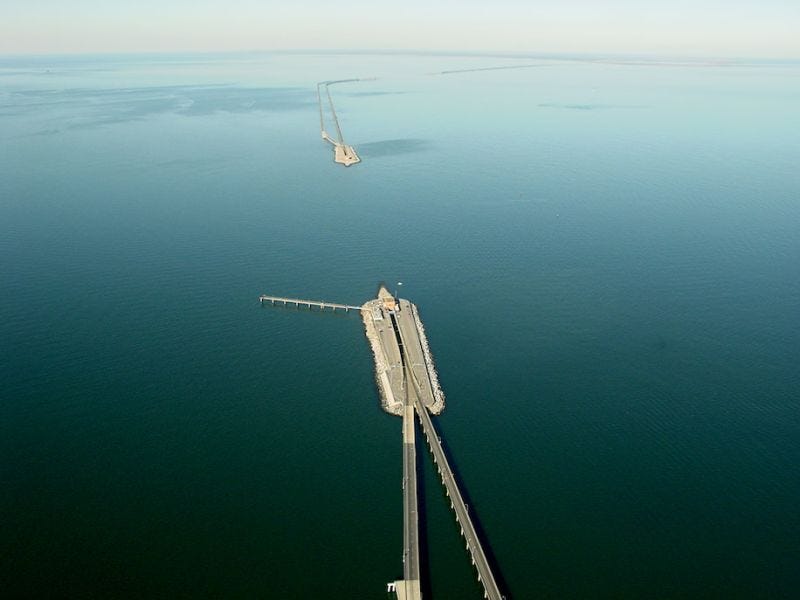
The Chesapeake Bay Bridge-Tunnel in Virginia is 28 kilometres long and spends most of that distance just 9 metres above the water.
Then it disappears beneath it entirely.
Opened in April 1964, the structure combines nearly 19 kilometres of low-level concrete trestle with two tunnels, each about 1.6 kilometres long, buried under the bay's main shipping channels.
The tunnels exist because the US Navy needed its ships to keep moving.
(so much innovation is unfortunately linked to military requirements)
A bridge collapse across two of the busiest navigation channels on the East Coast could have trapped much of the Atlantic fleet at Naval Station Norfolk, so the crossing goes under rather than over at those points.
Four artificial islands, each about 2 hectares in area, mark the transition points where the road descends from trestle to tunnel and back up again.
The trestle sections rest on 4,805 concrete piles driven into the bay floor, cut to a uniform height, and capped in groups of three to form the supports for the deck above.
The piles, if laid end to end, would stretch approximately 160 kilometres.
Getting the tunnel sections in place required a different approach: workers dug trenches in the seabed, lowered pre-fabricated tube sections from barges, bolted them together underwater, pumped them dry, and covered the whole assembly with fill.
Before the bridge-tunnel opened, ferries were carrying around 50,000 vehicles a month across the bay, a crossing that took 90 minutes and was frequently disrupted by weather.
The new fixed link cut that journey to about 25 minutes, rendering the ferries redundant immediately.
Until 2018, the Chesapeake Bay Bridge-Tunnel held the record as the longest bridge-tunnel complex in the world, a title that passed to the Hong Kong-Zhuhai-Macau Bridge.
Some drivers find the crossing unsettling enough that the local police department offers to send an officer to drive them across.
Some people find the crossing so unsettling that they hire drivers to take them across in their own cars.
Should be the poster note at every recruitment event. You summarised it so eloquently.
"Get involved in something where you feel you are part of an adventure. Where work is not just a means to an end — but actually makes you excited.
For engineers, this is mostly baked into our jobs.
Designing and building that which never was - creating it out of thin air. Providing opportunities for prosperity along the way.
It's great.
Engineering is perhaps the closest thing we have to magic on earth."